


A major challenge in academia when conducting participatory action research on social-ecological issues is how to engage local communities as collaborators rather than mere objects of study. As numerous studies have increasingly shown, this shift is fundamental to restoring human-nature relationships and enhancing more meaningful research practice and impacts.
At the Mexico City Node of the Water Trans-Path-Planning project, we have sought to apply collaborative methodologies that focus on horizontal and ethical perspectives. Central to our node work is to explore how the fragmented social fabric has persisted in resisting degradation and how it might be strengthened through learning exchanges that empower local actors towards enacting sustainable desired futures.
Seeds of resistance: Defending the essence of an agricultural wetland
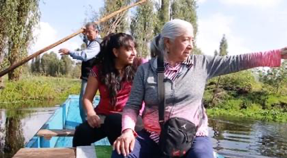
The turbulent waters at the drainage outfall of the Xochimilco peri-urban wetland, a site recognized for its biocultural richness (UNESCO World Heritage Site, FAO Globally Important Agricultural Heritage System), symbolize not just pollution but also the profound sense of injustice experienced by its inhabitants as they witness the ongoing degradation of their territory. The waters entangle conflicting emotions, making it difficult to distinguish between forces that sustain life and those that bring devastation.
Located in a peri-urban southern fringe of Mexico City—one of Latin America’s largest urban areas—the wetland is immersed at the intersection of urban concrete structures that diffusely intertwine with the vestiges of an agroecological lake landscape shaped by a long history of entrenched social-political dynamics, such as rapid urban expansion (through formal and informal settlements), unregulated tourism, and numerous development projects mostly implemented without local consultation or participation. Moreover, the influx of newcomers and changing livelihoods have contributed to the erosion of community bonds, straining and fracturing the social fabric (Convention on Wetlands, 2025).
Yet, if we further navigate into the heart and fringes of the wetland, we can still find persisting life beneath the water surface, revealing the wetland’s resilience as pale glints of hope for flourishing tomorrows. Amid the pressures faced within the area, various initiatives have emerged to foster territorial transformation through the care and protection of seeds. Seeds have been foundational in the ancestral agricultural systems (chinampas), which have historically supplied food to the city. Today, seeds in the chinampas are mostly used for cultivating food and ornamental plants. However, both the seeds and chinampas face environmental degradation and the gradual loss of their traditional caretakers. These living agricultural structures are increasingly fragmented by land grabbing and unregulated expansion of activities such as greenhouse agriculture, social events, and soccer fields. Meanwhile, seeds are threatened by commercial pressures that diminish the diversity of native and creole varieties, as well as the traditional knowledge essential to their preservation.
Achieving shared visions of more sustainable forms of living may seem utopian, making it even more crucial to rescue, value, and share the many and diverse experiences that persist within the wetland as a means to contribute to restoring communal ties and mobilizing a collective sense of place and agency.
Inquiring into transformative initiatives: unlearning to learn along the way
Our work began by identifying which actors are pursuing sustainable transformations in the area. Drawing from theoretical frameworks related to transformative change (Transformative Potential Framework, TPoF, Tuckey et al. 2023), we examined what could be considered Transformative Initiatives (TIs) at the local level. We used the IPBES (2024) definition: Transformative change is a process that involves fundamental, system-wide shifts in views, structures and practices in ways that address the underlying causes of social-ecological decline. We assessed the transformative potential through eliciting capacities associated with learning, empowerment, and networking.
However, engaging with these initiatives revealed deeper complexities shaped by decades of academic extractivism. This was manifested in questions posed by certain community members (what are your real interests; how does your research benefit us?) that exposed our evident position as outsiders with limited understanding of local life dynamics and struggles. This was instrumental in realizing that before identifying TIs with transformative potential, we needed to unlearn entrenched conceptions and pause our socially-constructed academic timelines to attune ourselves within the territory’s rhythms and social dynamics, and engage with social actors on their own terms. This also meant letting go of rigid approaches for planning the implementation of participatory methods, allowing us to be moved by the social and natural flows of the wetland. Only then were we able to pursue an ethical engagement with those who have cohabited the place in harmony for generations.
This process profoundly enriched our sensitivity beyond methodological constraints by experiencing (and not only knowing) the significance of nurturing care and building genuine relationships. To truly listen and accompany, we decided to avoid conventional tools such as interviews, dismantling usual unidirectional academic practices. Researching within a peri-urban wetland of this nature requires approaching the territory as a complex, and relational social- ecological system constantly changing and shaped by asymmetric power relations expressed through territorial control (Haesbaert, 2013; Escobar, 2015).
Weaving desired, shared, and situated futures
From our analysis, we identified 40 Transformative Initiatives (TIs) in the Xochimilco wetland and surrounding areas that resist dominant power structures through alternative ways of inhabiting the territory. We analyzed them to understand the political, ethical, and cultural dimensions they address, as well as their capacities for learning, empowerment, and networking. After identifying TIs with transformative potential, we pursued further dialogue with some of them.
One of these dialogues was with an initiative called XOMITLA Network, a collective of seed houses working in Xochimilco, Tláhuac, and Milpa Alta (three neighboring municipalities located on the outskirts of Mexico City). XOMITLA has offered us the opportunity to learn about their work defending the territory. Their empowerment efforts include workshops and training on planting techniques, seed conservation, and agroecological practices designed to strengthen community capacity to preserve agricultural heritage. These efforts revolve around exchanging local seeds, which keep diverse seed varieties alive and adapted to various microclimates while reinforcing community ties and fostering cooperation among families and local farmers. The textbox has some illustrative quotes on this.
The XOMITLA Network Initiative in the words of Claudia, one of the network’s members:
"XOMITLA is a community network dedicated to the conservation, safeguarding, and reproduction of local and open-pollinated seeds in the region of Xochimilco, Tláhuac, and Milpa Alta in Mexico City.
We work with four main objectives:
1) Conservation of local seeds – We focus on preserving native seeds, many of which are at risk of disappearing due to industrial agriculture and the decline of traditional farming practices. This includes varieties of corn, beans, chili, squash, and more.
2) Safeguarding and protection – The network’s seed houses serve as small storage centers where seeds are kept under optimal conditions to ensure their long-term viability. We also engage in seed exchange among network members, promoting genetic diversity and local adaptation.
3) Reproduction and multiplication – We encourage the reproduction and multiplication of these seeds on arable land. By planting and harvesting in each of the seed houses, we ensure these varieties remain alive and accessible for future generations.
4) Open pollination – The network prioritizes open-pollinated seeds—those that do not rely on artificial hybridization and can be naturally reproduced from their own seeds. This approach respects ecological cycles and supports local biodiversity."
XOMITLA plays a vital role in conserving agricultural biodiversity and reclaiming food sovereignty. By promoting the preservation and use of local seeds, the network helps communities reduce their dependence on commercial seed systems and thus strengthen their autonomy in food production.
Looking ahead, we aspire to expand the network to other regions of Mexico City and beyond, creating a model of seed conservation that is sustainable, accessible, and replicable. This vision also includes a strong focus on environmental education and raising awareness about the crucial role seeds play in ecosystem health and food sovereignty.
XOMITLA stands as a powerful example of how communities can unite to safeguard and promote their agricultural heritage, while building a more sustainable and resilient future in the face of growing climate and economic challenges.
Source: Video “Casa de Semillas Red XOMITLA” in collaboration with Xinastli, Lum K'inal, Dalias y Julietas, Fondo Acción Solidaria (FASOL), September 2024.
A tangible outcome of this meaningful engagement was a co-developed agreement that defined ethical forms of collaboration between the parties involved (Umbela NGO and XOMITLA Network), fundamental for weaving collective efforts that transcend conventional academic practices based on short-term projects and imposed agendas.
This experience represents an awakening call for embracing transformative change through creating meaningful transdisciplinary partnerships as collaborative endeavors based on nurturing genuine, respectful, and caring relationships among a diversity of individuals who engage in long-term shared commitments towards more sustainable, plural, and just futures.
References
Convention on Wetlands (2025). Agriculture and Wetlands: Maintaining and restoring wetlands for sustainable food production and ecosystem health. Supplementary Materials: Case study descriptions. Gland, Switzerland: Secretariat of the Convention on Wetlands. DOI: 10.69556/strp.tr13.25.supp.
Escobar, A. (2015). Territories of difference: the political ontology of the "derechos al territorio". Cuadernos de Antropología Social (41) 25-38.
Haesbaert, R. (2013). From: the myth of deterritorialization to multiterritoriality. [Conference session] Seminario Cultura y representaciones sociales UNAM. September 15, 2013
IPBES (2024). Thematic Assessment Report on the Underlying Causes of Biodiversity Loss and the Determinants of Transformative Change and Options for Achieving the 2050 Vision for Biodiversity of the Intergovernmental Science-Policy Platform on Biodiversity and Ecosystem Services (Transformative Change Assessment). O’Brien, K., Garibaldi, L., and Agrawal, A. (eds.). IPBES Secretariat, Bonn, Germany. https://doi.org/10.5281/zenodo.11382215
Kemmerink-Seyoum, Jeltsje (2025). Water and Development Partnership Programme. RDB thematic learning sessions. Presentation: Nurturing care and ethical collaborations in times of turmoil. 3 March 2025.
Tuckey, Aaron J. Harmáčková, Zuzana V. Peterson, Garry D. Norström, Albert V. Moore, Michele-Lee. Olsson, Per. Lam, David P. M. Jiménez-Aceituno, Amanda (2023). What factors enable social-ecological transformative potential? The role of learning practices, empowerment, and networking. Ecology and Society 28(2):27.
